Expertise

Characterisation and efficiency calibration of gamma detectors using MCNP

Characterisation of HPGe, CZT and scintillator detectors for gamma-ray spectrometry

Reduce costs associated with overestimating the radioactivity of waste and environments, as well as uncertainties surrounding these estimates.

Our innovative and rapid approach is based on proprietary software, combined with our expertise in experimental measurements, Monte Carlo modelling and the processing of gamma-spectrometry data. This characterisation solution enables players in the nuclear industry to accurately assess radioactive activities. The characterisation of your detectors (using MCNP) ensures that potential overestimates or underestimates are minimised, thereby providing reliable results to support decision-making.

Detector characterisation tool with MCNP

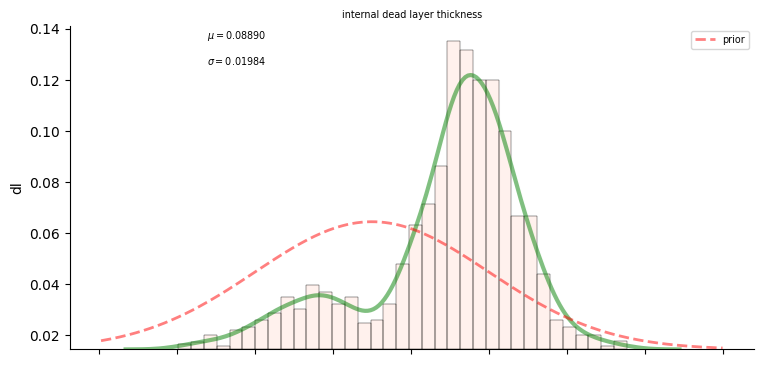
Radeo offers an innovative solution for the multi-parameter characterisation of gamma spectrometry detectors. This tool reduces discrepancies between measurements and simulations by adjusting unknown parameter values (see example 1). The software thus determines reliable efficiency curves and rigorously assesses the uncertainties associated with each parameter.

The method is based on the integration of the Monte Carlo code (MCNP) with a multi-parameter inference and optimisation algorithm, which enables the automatic adjustment of up to ten unknown parameters relating to the internal geometry of the detector.

Included deliverables:

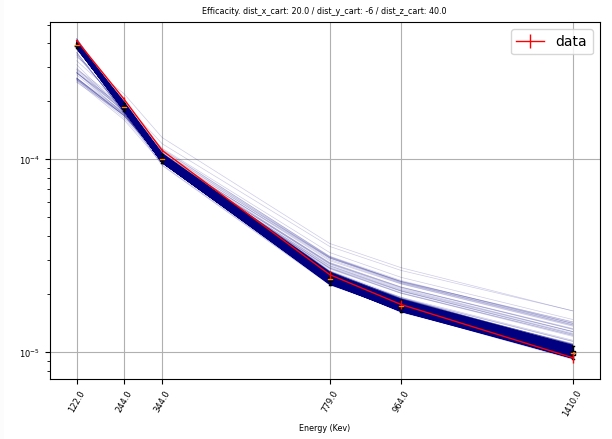
  • measured and simulated efficiency curves (see example 2),
  • the complete MCNP model of the detector,
  • a detailed technical report.

This method applies to all types of gamma spectrometry detectors (semiconductor detectors, particularly CZT detectors and scintillators).

Example 1: Adjustment of unknown parameter: the maximum of the green distribution indicates the most probable value of our unknown parameter. The estimated distribution before calculation with our software is shown in red.
Example 2: Adjusted efficiency curve (the experimental curve is shown in red, the curves from the characterization are shown in color, and the points represent the most probable efficiency values).

Characterisation of HPGe and CZT detectors using MCNP

 The performance of an MCNP model of an HPGe detector depends heavily on how its internal geometry is represented. The nominal dimensions provided by the manufacturer may differ from the detector’s actual geometry, particularly due to variations in the dead zone, the position of the crystal, the thickness of the materials or certain manufacturing tolerances.

Radeo combines experimental measurements and Monte Carlo simulation in order to identify the geometric parameters required to reproduce the detector’s actual response and to obtain an efficiency curve consistent with the measurements.

Why characterise a gamma spectrometry detector?

An activity expressed in becquerels (Bq), determined by gamma-ray spectrometry, depends directly on the detection efficiency used

A(E) = N(E) / (ε(E) × Iγ(E) × t)

With; 

  • N(E) : net number of collisions at the peak of total absorption at energy E;
  • Iγ : the gamma-ray emission yield at energy E of the identified radionuclide;
  • t : the measurement time in seconds

An error in the efficiency ε at energy E therefore has a direct impact on the calculated activity.

An inaccurate representation of the detector’s internal geometry may lead to discrepancies between simulation and measurement and introduce a bias in the assessment of activity.

Automatic adjustment of the MCNP model using AI and multi-parameter inference

Using a set of calibration measurements taken at selected positions, our software tool enables the unknown parameters to be adjusted so as to reproduce the experimental efficiency curves. Our method is based on the MCNP code and provides an accurate modelling of radiation-matter interactions, shielding effects and detector geometry.

The results enable more reliable efficiency calculations, more accurate assessments of radioactive activity in your environments, and a reduction in the need for field testing.

Which settings can be adjusted?

For example:

  • dimensions of the crystal;
  • position of the crystal;
  • distance between the crystal and the window;
  • thickness of the dead zones;
  • dimensions of certain internal layers;
  • geometric parameters for which little is known.

Example of Radeo characterisation

CZT H3D Case Study

  • Reference sources: 152Eu and 241Am 
  • 7 initially unknown geometric parameters, 91 experimental set-ups, energy range from 59 to 1409 keV.

After applying our tool

  • 80 per cent of the points show a difference between measured and calculated values of less than 18 per cent across a wide energy range.
  • Maximum deviation observed at 59 keV: <25 per cent, in an energy region that is particularly sensitive to internal dimensions and absorbing materials.

Outputs: Validated MCNP model + efficiency curve + uncertainties

Example 3: Distributions of the relative deviations between the efficiencies derived from the calibration measurements and the efficiencies determined by MCNP following characterisation

Why choose Radeo?

Technical support and collaborative R&D

Radeo supports its partners in the development of new detection and measurement technologies. Our collaborations with research laboratories and industrial partners enable us to co-develop specific tools, validate experimental models, and transfer advanced expertise. This service includes technical assistance, training, and participation in collaborative projects.

CONTACT US

Contact the Radeo team

Need assistance? Have a question? Want to join the team? Fill out the form!

Follow us on LinkedIn

Please leave us a message.

First name and surname *
Scroll to Top